
Why Alcohol-Free Fragrance
An honest, non-hype guide to oil-based perfume — projection, longevity, application, and who it tends to suit.
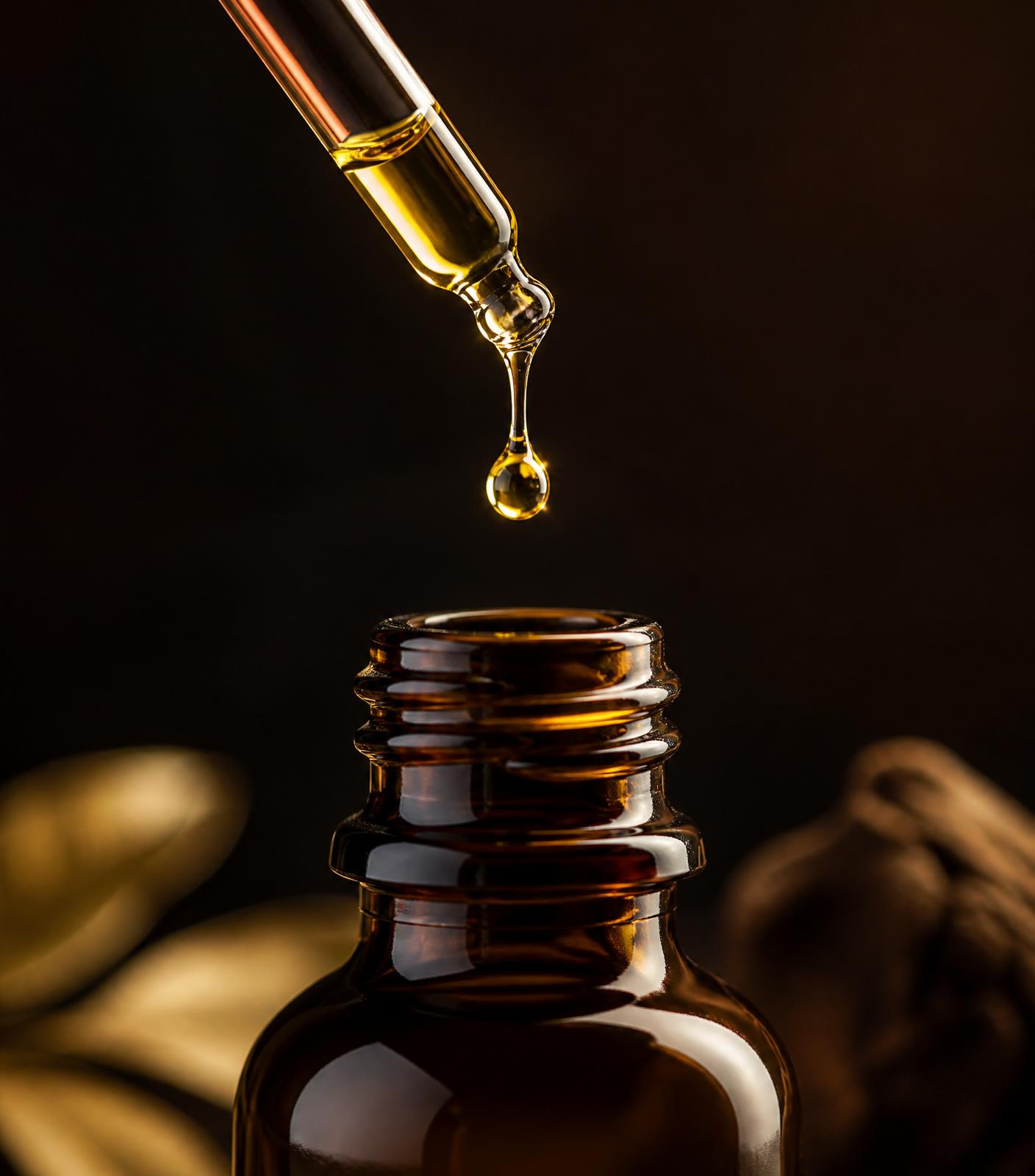
Long before spray bottles, fragrance was oil. Attars were warmed between the fingertips and traced onto the skin, drop by drop. Body oils were perfumed to be worn daily. Scent was something you applied, not something you announced.
Alcohol-based perfumery is the newer tradition, not the older one. Understanding what oil-based fragrance actually offers — and what it does not — helps you decide when to reach for it.
“An oil-based scent does not enter a room before you. It enters with you.”
What 'alcohol-free' actually means
Most modern eau de parfums are built on a base of denatured alcohol plus a small percentage of fragrance concentrate. The alcohol carries the fragrance into the air and evaporates quickly, giving the classic top-note lift.
An alcohol-free fragrance replaces that carrier with a skin-friendly oil — often a light, low-scent carrier such as fractionated coconut, jojoba, or a similar cosmetic-grade oil. The fragrance concentrate is dispersed into the oil rather than into alcohol.
That single swap changes almost everything about how the scent behaves.
Projection vs intimacy
Alcohol-based fragrance projects. It lifts off the skin, hangs in the air, and can announce your presence across a room. That is a feature, not a flaw — many people love it.
Oil-based fragrance stays close. It sits in the personal space around the wearer, usually within an arm's length. What you lose in projection, you gain in intimacy: the scent belongs to the moment you are already in, not to the whole room.
For some people, this is exactly the point. For others, it is a genuine limitation. Neither is wrong; they are simply different tools.
Longevity: quieter, but often longer
Because there is no alcohol flashing off, oil-based fragrance does not have the same 'peak and fade' arc. It opens more slowly, holds a softer heart for longer, and can remain detectable on skin many hours later.
You will not smell it as strongly on yourself as you would a fresh alcohol spray, because your nose adjusts quickly to any scent you are constantly around. Trust that it is still there.
Who tends to prefer oil-based fragrance
Two groups often gravitate toward oil-based scent.
Those who find alcohol-based sprays drying or reactive on their skin, and prefer a gentler carrier. This is not a medical claim — everyone's skin is different — but many people describe oil-based fragrance as more comfortable, and it can be worth patch testing to see how yours responds.
Those who want a more intimate scent signature — a fragrance for the people who come close, rather than for the entire elevator. Oil-based scent naturally fits that intention.
How to apply an oil-based fragrance
Warm the oil. Place a drop or two on a fingertip and warm it briefly between your fingertips or the pads of your thumbs. Warmth wakes up the top notes.
Press, do not rub. Press the oil into the pulse points — inside wrists, base of throat, behind the ears, sometimes at the nape of the neck. Rubbing aggressively bruises the top notes and shortens their life.
Apply to clean, moisturised skin. Fragrance holds onto oil molecules. Dry skin lets it evaporate quickly; well-moisturised skin holds it for hours longer.
Give it a minute. Let the scent settle before you dress. That first minute is when the composition finds itself on your particular skin.
A note on skin comfort
Any concentrated fragrance material — natural or synthetic, in oil or alcohol — can occasionally irritate sensitive skin. If you are prone to reactions, or you are trying a new fragrance for the first time, patch test on a small area (the inside of your forearm) and wait 24 hours before wearing it more broadly.
That is a general precaution, not a warning specific to oil-based scent, which many people find gentler than alcohol-based sprays.
A short history: attar and the oil tradition
Oil-based perfume — attar or itr — has been made across the Islamic world, Persia, Arabia, South Asia and North Africa for well over a thousand years. Steam distillation of aromatic materials was refined by early scholars and perfumers, and the resulting oils became a daily part of religious, social and domestic life.
That lineage matters. Alcohol-based perfumery, which most of the modern West treats as the default, is a comparatively recent European convention. Oil-based fragrance is not a novelty or a niche wellness format — it is the older mainstream, still central to how much of the world actually wears scent.
Where to apply — and where to be careful
The classical application points are the pulse points: the inside of each wrist, the base of the throat, behind the ears, and — in some traditions — the nape of the neck, the crease of each elbow, and the beard or hair.
Fabric and hair need slightly more care than skin. Perfumed oils can leave marks on silks, pale wool and delicate knits; keep application to skin and let the fabric fall over it rather than dabbing the fibre directly. On hair, oils can be beautiful (a trace on the ends carries a scent all day) but avoid heavy application on the scalp of very fine or oily hair.
Avoid the eye area and any broken or freshly shaved skin, where concentrated fragrance is more likely to sting.
Realistic projection expectations
An oil-based scent is not built to fill a room, and no amount of extra application will make it do so. If you catch yourself layering on more and more of an attar because you cannot smell it strongly on yourself, pause. You have gone nose-blind — the people around you can almost certainly still detect it.
The right measure for an oil is how it reads at conversational distance, not across a room. That is the point of the format.
Combining oil with an alcohol-based spray
The two formats are not competitors. They layer beautifully together, and this is one of the most useful techniques in modern perfumery.
Apply the oil first, to warm skin, and let it settle for a minute. Then mist a single spray of an alcohol-based fragrance in the same family above the collarbone or into the air in front of you. The oil holds the base and heart of the composition close to your skin; the spray gives you a moment of projection when you move.
The result is a scent with both intimacy and reach — quieter than a full spray, more expressive than an oil alone.
Frequently Asked
- Do alcohol-free perfumes last as long as spray perfumes?
- They typically last longer on skin, but project less. The scent stays closer to your body rather than lifting into the room.
- Are oil-based perfumes safe for sensitive skin?
- Many people find them more comfortable than alcohol-based sprays, but individual reactions vary. Patch test any new fragrance on a small area first.
- Can I spray an alcohol-based perfume on top of an oil?
- Yes. In fact, applying the oil first and misting the spray above the collarbone is a classic layering method that extends the life of both.
- Why does my alcohol-free fragrance smell stronger on someone else than on me?
- Your nose adapts quickly to scents you wear constantly. Others will still notice yours; you have simply gone nose-blind to it.
Be the first to know when the house opens.
A small circle. The occasional letter. No noise.