
Rose in Arabian Perfumery
A grounded, educational look at the flower that has quietly shaped Arabian perfumery for a thousand years.
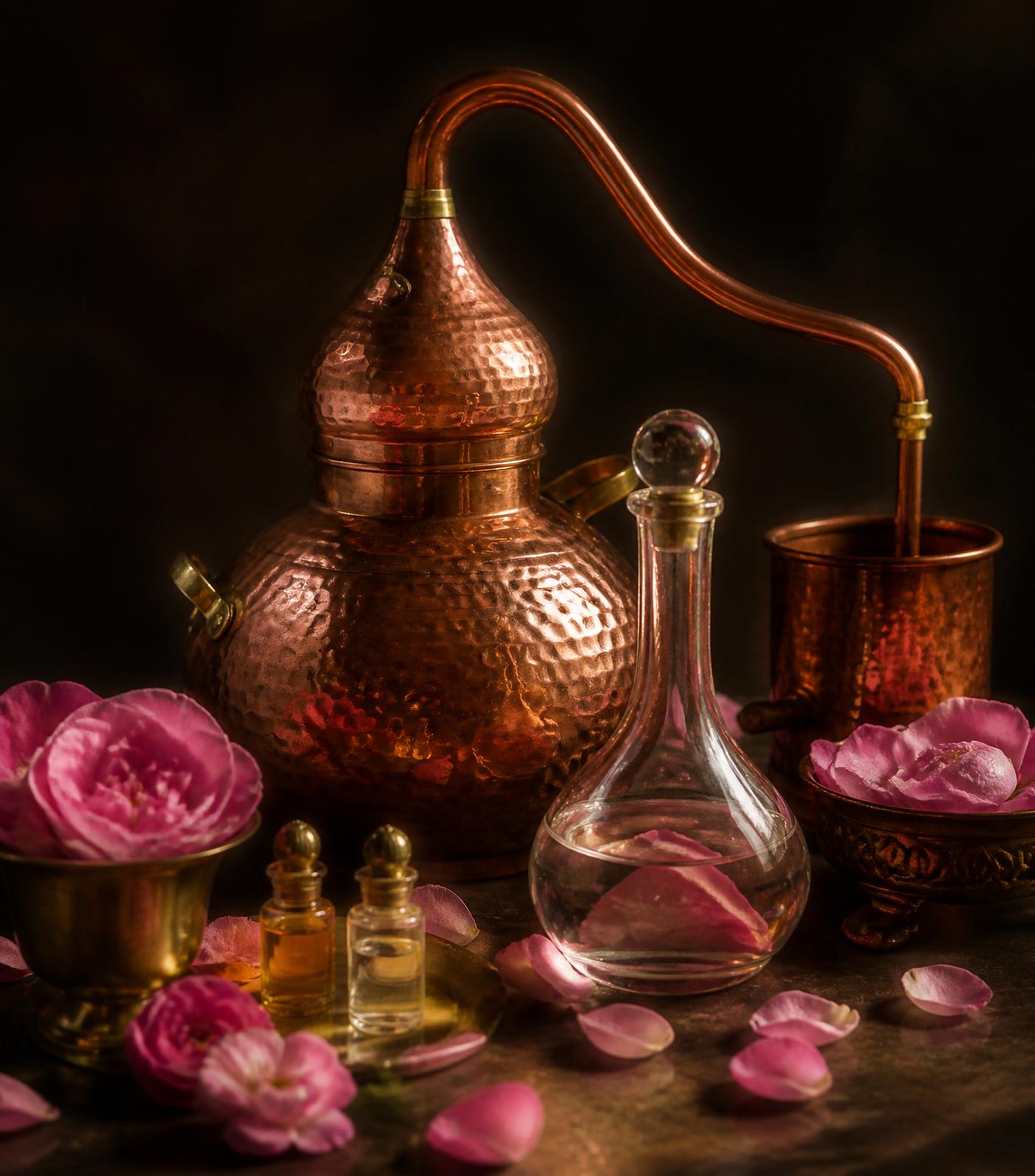
Ask most people to picture a rose and they will describe something fresh, green, faintly sweet, and slightly cool — the smell of a garden in June. That rose is real. But it is only one version.
The rose at the heart of Arabian perfumery is a different creature. Warmer, more resinous, almost jammy at times. Understanding why is a small door into the whole tradition.
“A rose in oil does not shout. It settles into the skin and stays.”
The rose that matters: Rosa × damascena
When perfumers speak of 'the perfumery rose', they usually mean Rosa × damascena — the Damask rose. It is a hybrid rose with a rich fragrance and a very specific chemistry that makes it exceptional to distil.
Damask rose is cultivated in a handful of famous regions. Taif in Saudi Arabia produces the celebrated ward al-Taifi. Isparta in Turkey is one of the largest producers of rose oil in the world. Kashan in Iran has centuries of tradition around rosewater. Bulgaria's Valley of the Roses supplies much of what the wider perfume industry calls 'rose otto'.
These regions do not smell identical. Taifi rose is often described as more spiced and honeyed; Bulgarian rose as brighter and more classically 'rosy'. Both are extraordinary. Both are Damask.
Rosewater, rose attar, rose absolute
Rose reaches the skin in three main forms, and knowing the difference clarifies a lot.
Rosewater (ma' ward) is the hydrosol that comes from distilling rose petals with water. It is used to scent homes and hands, to bless guests, and — in some households — in cooking. It is soft, aqueous, and gently floral.
Rose attar / rose otto is the essential oil produced by steam-distilling the petals. It is concentrated, expensive, and used by the drop. Distillation captures certain molecules; the resulting oil is warm, waxy, and slightly spicy on skin.
Rose absolute is extracted with a solvent rather than distilled. It captures a broader range of the flower's aroma, including its jammier, deeper facets, and reads richer and more voluptuous than the otto.
Why real rose is expensive
Rose is one of the most labour-intensive materials in perfumery. The petals are picked by hand in the pre-dawn hours, when the oil content is highest, and distilled the same day. It takes many thousands of petals to make a very small quantity of rose oil.
That labour, combined with the very specific climates where Damask rose thrives, is why fine rose attar sits in the same tier of pricing as materials like oud and true jasmine sambac.
Taif, Kashan, Damascus: a tale of three roses
The same Damask rose grown in different soils, altitudes and climates produces noticeably different oils. It is worth knowing the three names you will hear again and again in Arabian and wider Middle Eastern perfumery.
Taif, in the mountains of western Saudi Arabia, gave rise to ward al-Taifi — one of the most celebrated roses in the world. Grown at altitude, harvested in a very short spring season and distilled locally, Taifi rose is often described as honeyed, spiced, and almost balsamic. In classical Arabian compositions it is treated with the reverence given to oud.
Kashan, in central Iran, is the historic heart of rosewater. The annual Golab-giri (rose harvest) has been practised there for centuries; the resulting rosewater is used in mosques, homes and kitchens. Kashan-style rosewater tends to read softer, more culinary and hospitable than the perfumery-grade attars distilled elsewhere.
Damascus, in Syria, gave the Damask rose its name. Historic trade routes carried Damascene rose material west into Ottoman and European perfumery and east into South Asian attar traditions. The genetic line is essentially the same rose you meet in Taif and Bulgaria — a reminder that this flower is a shared inheritance across many cultures, not the property of any single one.
Rosewater vs rose oil: a quick clarification
The two are cousins, not twins. Rosewater is the aqueous by-product of distilling rose petals — high in water-soluble aromatic molecules, low in the heavier oil-soluble ones. It is gentle, refreshing, and used generously.
Rose oil (attar or otto) is the concentrated essential oil that separates from the water during that same distillation. It carries the heavier, warmer, waxier facets of the flower and is used by the drop. If rosewater is the flower's breath, rose oil is its pulse.
Why rose is culturally hospitable
In much of the Arab world, Iran and the wider Muslim world, rose is not only a perfume material. It is a gesture of welcome. Rosewater is sprinkled on the hands of arriving guests, added to sweets at weddings and Eid, and used to perfume prayer spaces.
Understanding this context changes how the note reads in a fragrance. Rose in an Arabian-inspired composition is rarely there to be pretty. It is there to be generous — to soften something denser, to offer warmth, to make room for the person wearing it.
A beginner's guide to smelling (and buying) rose
If you are trying to learn rose, do it in this order. First, smell a good rosewater — ideally a culinary-grade one from Kashan or Isparta. That is the flower at its gentlest.
Second, if you can, sniff a true rose otto or absolute on a blotter — not on skin — before you commit to a full fragrance. You are looking for a warm, waxy, honeyed, faintly spicy signature, not a dewy garden note.
Third, try rose in a mukhallat or perfumed body oil that pairs it with something else — oud, saffron or amber are the classics. That is how the flower is most often worn in Arabian perfumery, and it tells you more about rose than smelling it alone.
Avoid judging rose from a candle, a soap or an inexpensive synthetic. All three lean toward the fresh, soapy end of the spectrum and give a distorted picture of what the real material actually is.
How rose behaves in an oil
A perfumed body oil is not just a delivery system — it is a different acoustic space for a flower.
In an alcohol-based spray, rose is bright and airy. The alcohol lifts the top notes and evaporates fast, projecting a fresh rose signature before settling into whatever base was built underneath.
In an oil, rose is quieter and more sustained. It loses the dewy sparkle and gains depth, warmth, and skin-hugging staying power. Many people who think they dislike rose have only ever met the airy version. In an oil, especially warmed on skin, it can read closer to rose jam, honeyed petals, or a warm resin than to a fresh flower.
Why rose belongs with oud, amber and musk
Rose is one of the most generous partners in perfumery. It softens without disappearing, and it deepens without turning heavy.
With oud: rose smooths oud's animalic edges and gives it lift. The pairing — often called warda wa oud — is one of the great classics of Arabian perfumery.
With saffron: rose gains a leathery, slightly bitter shimmer. The two together read regal and unmistakably Middle Eastern.
With amber: rose turns honeyed and glowing. The combination is warmth on warmth, made for cooler weather and quiet evenings.
With musk and sandalwood: rose becomes intimate, powdery, and close to skin — a signature many people wear for years.
How to wear rose in oil
Rose in oil rewards restraint. A drop or two at the pulse points is usually plenty. Warm it briefly between the fingertips, press it — do not rub it — into the skin, and give it a minute to bloom before layering anything on top.
If you like rose but find it 'too floral' in sprays, an oil-based rose is worth revisiting. It is essentially the same flower, listened to at a different volume.
Frequently Asked
- What is the difference between rose attar and rose absolute?
- Rose attar (or rose otto) is steam-distilled; rose absolute is solvent-extracted. The otto tends to be warmer and waxier; the absolute is deeper and jammier. Both are 'real' rose.
- Is Taifi rose better than Bulgarian rose?
- They are different, not ranked. Taifi rose is often more honeyed and spiced; Bulgarian rose is brighter and more classically floral. Preference is personal.
- Why does rose smell different in an oil?
- An oil base slows evaporation. You lose the fresh, dewy top and gain a warmer, longer-lasting heart. Same flower, different acoustics.
- Can men wear rose?
- Rose has been a masculine note in Middle Eastern perfumery for centuries, especially paired with oud, saffron and leather. The 'rose is feminine' framing is a modern Western convention, not a universal one.
Be the first to know when the house opens.
A small circle. The occasional letter. No noise.